“Grape-like aromas” keep mosquitoes at bay

mosquito_terror_by_kittenmittenmuffin-d5bgh44The mosquito is my dad’s nemesis in the insect world. He will go to extraordinary lengths to secure his person from mosquito attack, roaming the corridors on night patrols and jamming mosquito repellent devices into every possible plug socket.

Such devices are usually based on the chemical, N, N-diethyl-meta-toluamide, or DEET. The problem with DEET is it’s expensive, it has nasty effects on our own skin and mosquitos are evolving resistance to it.

But replacing DEET has proven a tricky business, since we don’t really know exactly how it prevents mosquitoes zeroing in on their bloodbag human targets.

Until now.

A team of researchers from the University of California found that mosquito nerve cells in the antenna expressing the receptor Ir40a were crucial for the anti-DEET effect. When this receptor was blocked, mosquitoes became resistant to DEET – and in a nightmarish twist, some became more drawn to its scent.

They then used a computer algorithm to screen over 3000 “natural odours”, including extracts from plants, insects or vertebrates, and ones already approved for use in perfumes, cosmetics and food additives, for their predicted ability to block Ir40a receptors.

Three promising compounds with a “grape-like aroma”, plus a fourth that ants secrete to mark their trail, had strong effects on nerves expressing Ir40a and repelled mosquitos.

Since these compounds already have WHO and FDA approval, they are exciting new candidates for an improved class of bug repellents that could be speedily translated to market.

Kain, P, Boyle, SM, Tharadra, SK, Guda, T, Pham, C, Dahanukar, A, & Ray, A (2013). Odour receptors and neurons for DEET and new insect repellents Nature : 24089210
Posted in Disease, Science | Tagged , , , , , | Leave a comment

How to: boost resistance to tuberculosis

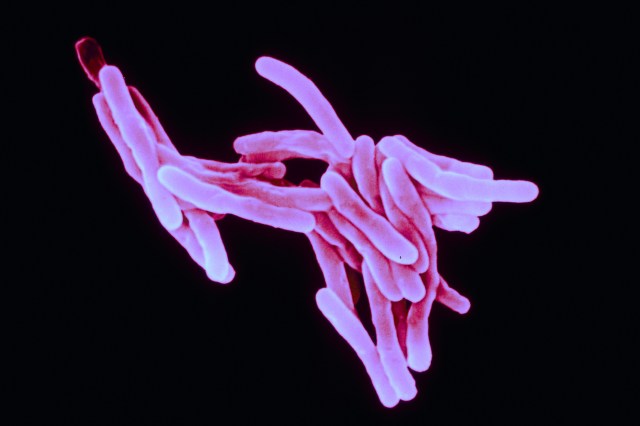
Mycobacterium tuberculosis

Most kiddies receive the very effective Bacille Calmette-Guérin (BCG) vaccine against tuberculosis during childhood, but as they grow up, the protection afforded by this vaccine wanes.

Since cases of adult TB are on the rise, receiving an immune upgrade would be a great benefit to boost immune protection.

One team of researchers at McMaster University, led by Professor Zhou Xing, have now developed a new booster vaccine based on adenovirus, which causes the common cold.

In 26 healthy adults, they showed that this vaccine could generate robust immune responses against TB. Anti-TB immune cells created by the booster vaccine performed better in people that had previously received the childhood BCG vaccine, secreting a wider range of protective immune factors.

Since this novel booster vaccine has proven safe and very effective at reawakening TB immunity in BCG-vaccinated healthy adults, it will now move on to the next stages of clinical trials.

Smaill F, Jeyanathan M, Smiejal M, Medinal MF, Thanthrige-Don N, Zganiacz A, Yin C, Heriazon A, Damjanovic D, Puril L, Hamidl J, Xie F, Foley R, Bramson J, Gauldie J, & Xing Z (2013). A Human Type 5 Adenovirus–Based Tuberculosis Vaccine Induces Robust T Cell Responses in Humans Despite Preexisting Anti-Adenovirus Immunity Science Translational Medicine, 5 (205) DOI: 10.1126/scitranslmed.3006843

Posted in Bacteria, Disease, Immunology, Medicine, Microorganisms, Science, Vaccines | Tagged , , , , , | Leave a comment

A Marvellous Month of Infectious Science

Cold weather helps to spread flu across the country

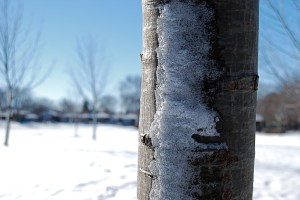
snowA very cool new study from McMaster University researchers shows how weather patterns impact the spread of influenza A virus across Canada. Using outbreak data gathered over more than 13 years, the virus could be tracked over time and space. Influenza A tended to first emerge in the colder, less humid provinces of Western Canada (British Columbia and Alberta), and then spread across the country to the East. Schools also represented hotbeds of infection – when they were shut during the Summer, there were significantly fewer cases of flu recorded.

Investigating the ‘ouch’ factor during a bacterial infection

nerveWhen a bacterial infection takes hold, it’s usually a painful experience. During a normal immune response, immune cells infiltrate the infected area, pummel the invading bacteria and in doing so release molecules that cause swelling and pain. Yet new research from Harvard Medical School shows that it’s not only the immune system that is to blame: at least some of the pain comes from the bacteria themselves secreting factors that can interact directly with our nervous system.

The immune system’s need for speed

speedOur beautiful human bodies have several portals where nasty pathogens, such as bacteria, can enter and wreak havoc. Once inside the human body, bacteria start reproducing straight away, doubling their numbers around once every 20 minutes. Yet our immune T cells constantly patrol such vulnerable open-access areas, sampling their environment to identify threatening material. A reassuring new study has now come out showing that reactive T cells sense such foreign material within a few seconds, and make the decision to respond to malevolent threats within a speedy minute.

Edible vaccines, om nom nom!

OLYMPUS DIGITAL CAMERARotavirus infection is one of the major nasty causes of childhood diahorrea, but can happily be prevented with an oral vaccine. Vaccinated children in industrialised countries develop 85-98% immune protection, while those in the third world develop a much lower protection level of 50-60%. The reasons behind this startling difference are not well characterised, but third world kiddies would obviously benefit from a boost in their rotavirus immune protection.

One team has come up with a new way of administering such an immune upgrade – by loading rice, a staple food in the third world, with anti-rotavirus immune-boosting antibodies. This tasty dish could conceivably be consumed regularly during childhood to maintain protection levels.

Originally posted on Scizzle.

Posted in Bacteria, Disease, Immunology, Microorganisms, Science, Vaccines, Viruses | Tagged , , , , , , , , , | Leave a comment

The fairly depressing picture of pesticide pollution in British rivers

2405003862_2c3ece1e79_bLots of pesticides – such as the organochlorine insecticide, DDT – that were widely used in the fairly recent past are now banned after having serious effects on the health of humans and other species.

Yet old and new pollution of rivers and streams is still an issue across Europe, since waste water treatment practises don’t remove potentially harmful substances like pesticides, toxins, synthetic hormones and pharmaceutical drugs.

One team of researchers wanted to assess the levels of contaminants and the state of river recovery across 33 rivers in South Wales, UK, that were badly polluted in the past. To do this, they sampled toxin levels in the eggs of the Eurasian dipper (Cinclus cinclus), a waterbird that is well known to act as a pollution bioindicator.

cinclus_cinclus_2332They found that eggs from urban areas contained higher levels of modern pollutants, like toxic PCBs and PBDEs, while eggs from rural areas had higher levels of old agricultural pollutants, such as the pesticides DDE (a breakdown product of DDT) and dieldrin.

When the team compared current pesticide levels with those recorded 20 years ago, there was little or no reduction, and the concentrations of some pesticides – such as HCB and lindane –  had actually increased to levels high enough to affect bird development.

This research indicates that British water wildlife is not being properly protected by current legislation governing levels of toxic substances in rivers, and a new approach to water security is badly needed.

Paper: http://goo.gl/OZ6Dtj

Morrissey CA, Stanton DW, Pereira MG, Newton J, Durance I, Tyler CR, & Ormerod SJ (2013). Eurasian dipper eggs indicate elevated organohalogenated contaminants in urban rivers. Environmental science & technology, 47 (15), 8931-9 PMID: 23819781

Posted in Ecology, The Environment | Tagged , , , , , , , , , , , , , | Leave a comment

Magnificently Mathematical Mussels

2898357773_22f8feafb3_bDespite the ease with which mussels can be cooked and eaten with chips, harvesting these tiny shelled bivalves from the seashore requires a certain amount of industrious prising.

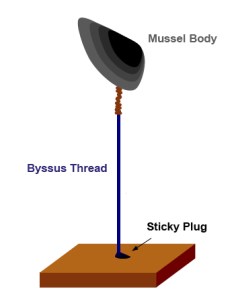
That’s because mussels use multiple thin byssus threads to securely fasten themselves to different surfaces along the coastline. These threads have a sticky plug at one end, with the mussel’s body dangling off the other (shown below).

musselScientists have found it difficult to explain how mussels tolerate the forces generated by constantly crashing waves and strong sea currents, since the calculated strength of the byssus threads alone is too low to withstand them.

So, how exactly do mussels manage to stay attached to a rocky coastline, or the hull of a fast-moving ship?

Researchers at MIT explored this question by collecting mussels from Boston harbour, and testing them under different conditions.

They found that byssus threads are not made up of the same material all the way through. Instead, the thread sports a mixture of soft and hard material that optimises its ability to resist impact forces.

The soft material nearer to the body of the mussel deforms as mechanical forces are applied, while the hard material closer to the sticky plug stays in a very relaxed state until substantial force is applied.

This geometric structure results in a 900% increase in the mussel’s ability to withstand repeated bashing by waves (dynamic strength) compared to its ability to resist constant pressure (static strength).

This arrangement also conspires to create the least amount of force at the junction between the mussel’s body and the byssus thread, minimising the likelihood of a horribly wrenching separation.

Other animals using this ingenious materials design include the mantis shrimp and certain ancient fish.

This research has wonderful implications for the bio-design of new materials that need to withstand significant push/pull forces, such as submarines, wind turbines and materials going into space.

Qin Z, & Buehler MJ (2013). Impact tolerance in mussel thread networks by heterogeneous material distribution. Nature communications, 4 PMID: 23880603

Posted in Bioengineering, Ecology, Marine | Tagged , , , , , , , , , , | Leave a comment