Using pseudogene expression profiles to classify tumours & predict cancer prognosis

Pseudogenes are genes that have accumulated so many mutations that they can’t code for or create proteins any more.

4626751428

Now, scientists at the MD Anderson Cancer Centre have shown that characterising a cancer patient’s catalogue of pseudogenes can not only reveal what sub-type of tumour they have, but can also predict how they will respond to therapy and what their survival rate might be.

This creates an exciting new opportunity for the development of new prognostic tools that can potentially be used on a patient-by-patient basis.

Image credit: ynse via flickr.

Repost from the Stojdl Lab blog.
Posted in Cancer Immunotherapy, Immunology, Science | Leave a comment

Moving towards a universal immunosignature diagnostic platform for cancer

Scientists at Arizona State University have moved closer towards a universal immunosignature diagnostic platform for cancer.

Publishing in the journal PNAS, they describe the use of a platform that applies antibodies circulating in the blood of cancer patients to a large microarray of random peptides. Those antibodies that bind to one or more peptide are then characterised to create an “immunosignature” for each individual patient.

When the immunosignatures of multiple patients are compared, it becomes possible to pick out common peptides that keep cropping up. These could form the basis of a diagnostic test for cancer that would only require a drop of a patient’s blood. It may also be possible to use these peptide immunosignatures to inform the most effective type of cancer treatment.

4613535816
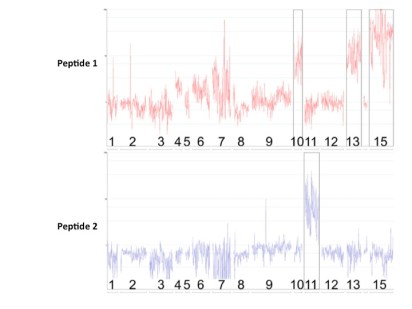
In the figure above, the expression levels of two immunostimulatory peptides are determined for 1516 cancer patients across 15 different cancer types. Peptide 1 shows high expression in 3 classes of cancer (10, 13 & 15), while peptide 1 is only expressed at high levels in 1 class of cancer (11).

Image credit: Stafford et al. 2014.

Repost from the Stojdl Lab blog.

Posted in Cancer Immunotherapy, Immunology, Science | Leave a comment

Digging into the soil microbiome of New York City’s Central Park

As the Summer looms and picnics become more the vogue, have you ever considered how many bugs live beneath the grass where you’ve spread your picnic blanket?

If you’ve gone off to a city park for your picnic, you might expect the number of bugs to be fairly low.

WRONG!

4617723517

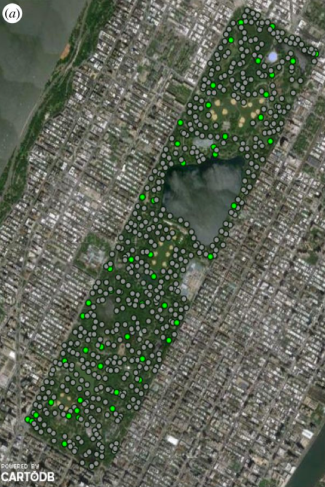
Scientists investigating the diversity of the soil in Central Park in New York City took samples of soil every 50m across the 3.4km2 area. They used these soil samples to analyse the number and type of microbes living in the dirt, including bacteria, archaea and eukaryotes.

All together, they found 167,000 species! On average, each single soil sample had about 7000 bacteria and archaea, and 1250 eukaryote species.

Image credit: Ramirez et al. 2014.

Repost from the Stojdl Lab blog.

Posted in Bacteria, Ecology, Microorganisms, Science, The Environment | Leave a comment

Latest research​ suggests that the presence of Tregs might not be bad news for every type of cancer

Regulatory T cells, or Tregs, are immune cells that are typically considered bad news for cancer patients. That’s because these cells are immunosuppressive, and can prevent the patient’s own immune cells from attacking and clearing their tumour. Essentially, the Tregs are recruited by the tumour to act as a protective shield.
Yet new research from scientists in China suggests that Tregs aren’t always bad. In some cancers, the presence of many Tregs in the tumour can actually correlate with improved survival.


4624542299
 

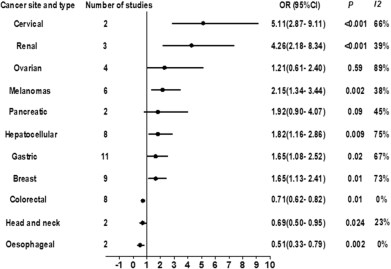
Taken directly from their new paper, the risk graph above shows that patients with cervical, renal, skin, liver, gastric and breast tumours that were densley packed with FoxP3+ Tregs had a significantly shorter overall survival (their odds of survival, which is numerically considered along the horizontal axis, was lower). Yet increased infiltration of FoxP3+ Tregs was associated with an improvement in the odds of survival for patients with colorectal, head and neck, and oesophageal cancer.

Image credit: Shang et al. 2015.

Repost from the Stojdl Lab blog.

Posted in Cancer Immunotherapy, Immunology, Science | Leave a comment

Overexpressing Notch1 in regulatory T cells unlocks T cell proliferation

4626860738

Tumours typically recruit regulatory T cells (Tregs) to suppress the activity of other T cells. This effectively prevents T cells from targeting – and destroying – the tumour.

Now, a team of scientists from Harvard Medical School have shown that overexpressing a fragment of a protein called Notch 1 in Tregs reverses their activity – and helps them promote T cell function. Although this team’s research is based in a model of immune tolerance, it has key (positive) implications for cancer immunotherapy strategies.

Image credit: Scientific Illustration for the Research Scientist.

Repost from the Stojdl Lab blog.

Posted in Cancer Immunotherapy, Immunology, Science | Leave a comment