A huge variety of fungi call your feet home

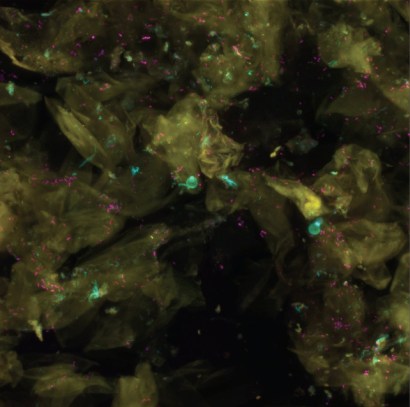
Skin Fungal DiversityHuman skin is a hardy, water-resistant covering that keeps important biological stuff from falling out of the body. It’s also a camping ground for millions of bacteria (picked out in magenta, above), fungi (seen in blue-green, above) and yeast that mostly hang out minding their own business and getting on with their lives. Sometimes, though, in particularly warm and moist areas, they grow a bit overexuberantly and cause problems.

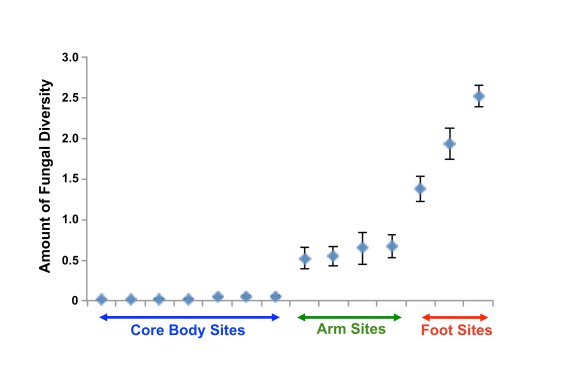
Athlete’s foot and toenail infections are two common examples of fungi gone wild. One team of researchers from the National Institutes of Health in Bethesda, USA, were interested to find out if the levels and types of fungi found on the foot predisposed it to fungal disease. So, they recruited 10 healthy adults, swabbed them in 14 different anatomical areas, including the feet, and ran genetic analyses on the sampled fungi.

8 of those 14 swabs were taken from core body parts – the inner ear, behind the ear, chest, back, nostril, scalp, the crease between the thigh and torso and the space between the eyebrows. These areas were totally dominated by fungi from the Malassezia genus, with an average of 6 different types observed.

3 of those 14 swabs were taken from the arm – at the elbow crease, palm and forearm – and these showed a richer level of fungal variety, with an average of 25 types identified.

The final 3 swabs were taken from the feet – the heel, toenail and between the toes – and returned a huge spectrum of fungal types. On average, 50 different varieties were found.

Fungal DiversityWhen some of the volunteers returned a few months later to be freshly swabbed, the core body and arm sites still housed the same types of fungi. On the feet, though, while there was still a huge assortment of fungi present, they were not the same communities that had previously been sampled.

This suggests that the normal exposure of the foot to the outside world causes constant shifts in microbial ecosystems that present opportunities for pathogenic fungi to become established. So, the relatively high propensity for fungal outbreaks on the foot – where up to 60% of “healthy” people have underlying infections – could definitely be explained by the highly changeable nature of the fungi that live there.

Paper: http://goo.gl/SfVSs

Findley K, Oh J, Yang J, Conlan S, Deming C, Meyer JA, Schoenfeld D, Nomicos E, Park M, NIH Intramural Sequencing Center Comparative Sequencing Program, Kong HH, & Segre JA (2013). Topographic diversity of fungal and bacterial communities in human skin. Nature, 498 (7454), 367-70 PMID: 23698366

Posted in Disease, Fungi, Genetics, Medicine, Microorganisms, Science | Tagged , , , , , , | 1 Comment

Vaccine delivers an immune double whammy to fight tuberculosis

TB chest X-Ray

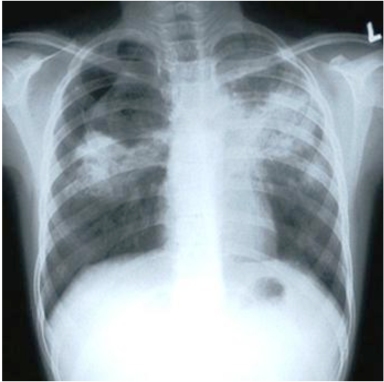
Vaccination is a hugely important public health intervention, perhaps the biggest in the history of mankind. While many childhood diseases are now effectively controlled by immunisation programs (as long as parents vaccinate their kids), there is still no effective vaccine for other serious infections like adult tuberculosis (TB).

Most adult TB vaccines under development focus on boosting the “adaptive” immune response to generate highly activated immune cells to fight off M. tuberculosis bacteria. New research has now revealed that it’s also important to consider how such vaccines impact the “innate” immune response, which exists in a state of constant readiness to repel pathogenic invaders.

In a collaborative effort from the McMaster Immunology Research Centre in Canada, researchers first administered a basic TB shot to set up a foundation level of anti-TB immunity. Then, since tuberculosis-causing bacteria enter the human body via the lungs, the team delivered a second inhaled vaccine designed to boost immune cells at the site of pathogen invasion. Two different inhaled vaccines were used, based on adenovirus or vesicular stomatitis virus (VSV).

While both inhaled vaccines generated similar levels of adaptive immunity, the VSV vaccine was not as good as adenovirus at producing robustly activated, multi-functional innate immunity. This led to a poor anti-bacterial effect, and a lack of protection against M.tb bacteria.

The unique nature of each inhaled vaccine appears to be responsible for this difference in outcome. VSV enters lung cells in a certain way, attaching at different sites, activating different intracellular pathways, expressing different viral products and consequently engaging different parts of the immune system. The two different vaccines programmed the two arms of the immune system differently, and the vaccine that engaged adaptive and innate immunity together did the best job at controlling tuberculosis infection.

This research should help to drive the intelligent design of future vaccines against pathogens like HIV and chlamydia, which enter at similar interfaces where the body meets the outside world.

Jeyanathan M, Damjanovic D, Shaler CR, Lai R, Wortzman M, Yin C, Zganiacz A, Lichty BD, & Xing Z (2013). Differentially imprinted innate immunity by mucosal boost vaccination determines antituberculosis immune protective outcomes, independent of T-cell immunity. Mucosal immunology, 6 (3), 612-25 PMID: 23131783

Posted in Bacteria, Disease, Immunology, Microorganisms, Science, Vaccines | Tagged , , , , , , , , , , | Leave a comment

Turning insect viruses into cancer therapies

Gene therapy is a pretty promising approach for lots of different diseases, and has already overcome a huge hurdle with the approval of the very first gene therapy product, Glybera, by the European Commission in 2012.

At its core, gene therapy uses a delivery vehicle to deposit a chunk of DNA in particular cells of the body. That courier is often a virus that has evolved to penetrate cells incredibly efficiently, and its genetic payload can be designed to normalise a cell if it’s simply defective, or to kill it if it’s cancerous.

But taking a human virus and reprogramming it for good rather than evil is not a trivial task. You have to be sure that there’s no risk of inadvertent infection and nasty disease, and you need it to stick around long enough to do its job. That means it has to be able to avoid detection – and destruction – by the immune system.

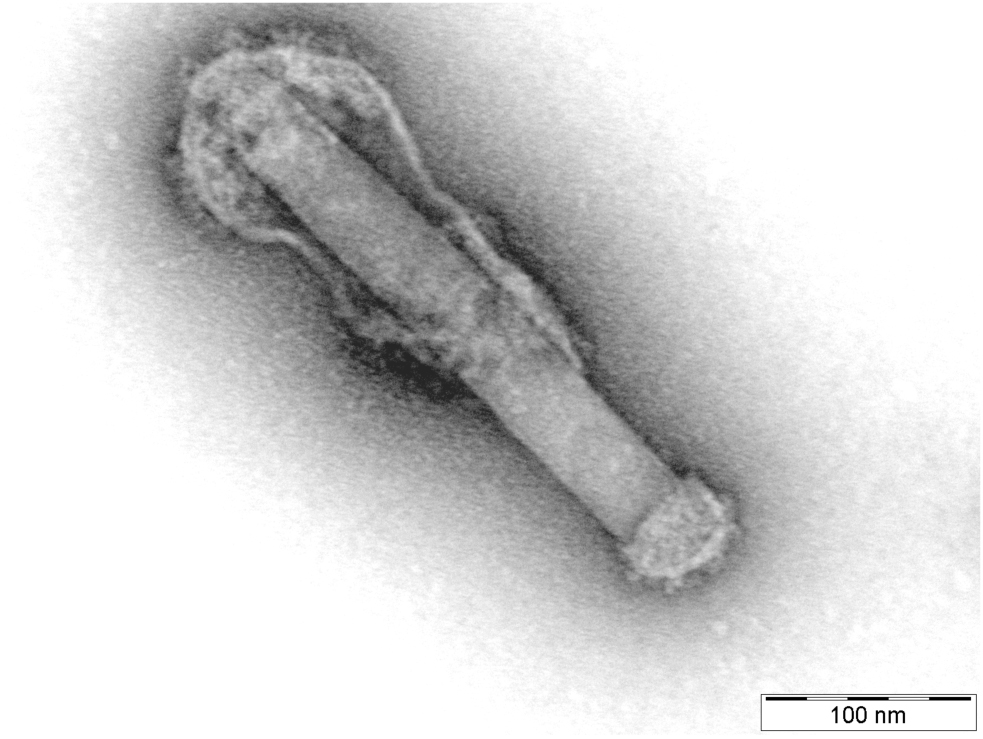
Happily, German scientists discovered in 1995 that an insect virus, baculovirus (shown below), is able to enter, but not replicate in, human cells. So there is no possibility of unintended illness, and since humans aren’t typically exposed to insect viruses, they don’t come under immediate memory immune attack.

baculovirus

(c) V. Dussupt

Now, a team of researchers (disclaimer: one of them was me) have put baculovirus through its paces to determine its utility as a gene therapy vehicle for prostate cancer.

When mixed with cells isolated from tumour or normal patient prostate biopsies, baculovirus delivered its DNA payload to lots of cancerous cells but relatively few normal ones. This preference for tumour cells is a great safety feature, since normal tissues wouldn’t be badly affected by the virus if it was carrying a toxic payload.

In three-dimensional models of the human prostate gland, baculovirus was able to poke its way through several layers of cells, a really important feature that boosts the rate of tumour shrinkage in real-life treatment scenarios.

These newly uncovered aspects of baculovirus behaviour are pleasingly positive, and make this virus an intriguing new delivery vehicle for prostate cancer gene therapy.

Swift, S., Rivera, G., Dussupt, V., Leadley, R., Hudson, L., MA de Ridder, C., Kraaij, R., Burns, J., Maitland, N., & Georgopoulos, L. (2013). Evaluating Baculovirus as a Vector for Human Prostate Cancer Gene Therapy PLoS ONE, 8 (6) DOI: 10.1371/journal.pone.0065557

Posted in Disease, Medicine, Microorganisms, Science, Viruses | Tagged , , , , , , , | Leave a comment

Fish parasite inspires sticky surgical tissue patch

organs

(c) Myotis

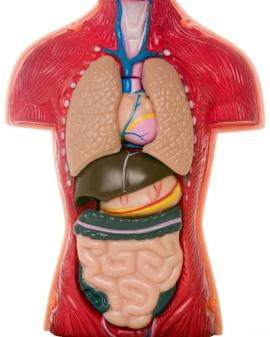
Surgeons still find it tricky to quickly and reliably stick a wet, slippery organ back together during invasive procedures. The currently available selection of ‘stick-you-together’ products – staples and chemical glues – do a decent job, but make a bit of a mess of nearby nerves and blood vessels, and often cause swelling, itching, scarring and, sometimes, infection.

Yet lots of parasitic organisms have evolved excellent ways of entering – and sticking to – their host. The freshwater fish parasite, Pomphorhynchus laevis, also known as the spiny-headed worm, gets eaten by an unsuspecting fish and travels through the digestive tract. Once it reaches a prime spot, it anchors itself firmly in the slippery intestines, ramming its proboscis deep into the intestine wall, inflating the tip, and forming a tight, interlocking grip on the tissue.

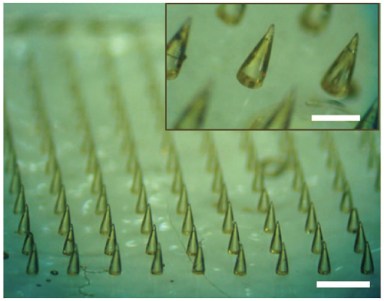
A team of researchers from Harvard have taken inspiration from this ingenious design to develop a small microneedle patch (shown below) to hold together organs. The patch glides smoothly and non-invasively into tissues and, once embedded, the tips of each tiny needle absorb water from the interstitial fluid that bathes every cell. These tips swell to their maximum size within 10 minutes, forming a bulbous end like an arrow head that gives the patch great sticking power.

microneedle matIn a test run on a pig, the microneedle patch attached skin grafts better than the current gold standard (staples), and there was less associated contamination from nasty bacteria. After the tissue healed, the microneedle mat could be easily removed, and the tiny holes it left behind sealed within a few hours. Once out of the liquid tissue environment, the swollen tips shrank back to their original size and shape, and were ready to be sterilised and re-used.

All-in-all, a mightily impressive bit of bioengineering!

Yang SY, O'Cearbhaill ED, Sisk GC, Park KM, Cho WK, Villiger M, Bouma BE, Pomahac B, & Karp JM (2013). A bio-inspired swellable microneedle adhesive for mechanical interlocking with tissue. Nature communications, 4 PMID: 23591869

Posted in Bioengineering, Marine, Microorganisms, Parasites, Science | Tagged , , , , , , , , , | 2 Comments

It’s great to be a woman scientist; it’s challenging to be a woman scientist

RosieTechI recently volunteered to help organise an event run by the Canadian Science Policy Centre that looked at the status of women in science and technology. To be frank, I was mightily fearful about participating in such an event. I had the idea that it would quickly degenerate into a depressing evening of man-bashing.

Yet, as it turned out, it was actually a wonderfully empowering, evidence-based look at women working in STEM fields (or maybe I just thought so because I travelled to the meeting listening to the Spice Girls – the ultimate in female power).

Wendy Cukier and Dr. Maydianne Andrade first described that while overt gender discrimination no longer exists (for a recent convert to the ridiculously sexist show Mad Men, this is good news), subtly muted gender discrimination does. We have to acknowledge this reality, even if it doesn’t affect us personally.

Gender bias almost appears to be written into our basic subconscious – and the fabric of our society. It flows in many different directions: it doesn’t just come from men directed at women. Some fields are overtly biased against men – 2012 was the first year a male midwife graduated from a Canadian university. And women can be biased against other women. So improving everyone’s awareness about gender balance is important. As Dr. Robin Duncan said, being self-perceptive about your own biases can help you to consciously counter them. Dr. Maydianne Andrade suggested taking Harvard University’s online test Project Implicit as a first step in that direction.

A remarkably soothing message that came through was that You. Are. Not. Alone. Every person in every workplace in the world encounters the gender issue, although it’s more evident in certain fields – such as computing, engineering, maths and the physical sciences. While women have made inroads into the life sciences (left graph, in purple, below), it is pretty depressing to see how few women go into and stay in other scientific fields (right graph, in purple, below).

stemgraphs2Being apathetic about balancing out the ratio of men to women in the workplace is remarkably easy. I used to be solidly indifferent myself. Wendy Cukier underscored that the decision to instigate change comes from essentially political powers, who are often resistant to such turbulence until enough pressure, advocacy and active engagement occurs.

One particular area in academia that was highlighted as prime for change was the way that in-house applications for pots of research funding get reviewed. Inherent bias in this system was first outlined in 1997 in a paper that analysed outcomes of postdoctoral grant applications to the Swedish Medical Research council. In these reviews, female applicants were consistently ranked lower in all categories, even though their research had the same level of scientific impact, and these review panels were made up of both men and women.

This is startling. Yet the solution is stunningly simple: to blind grant reviewers to the names (and consequently, genders) of the applicants. Research shows that this approach works. Yet few institutions seem to do it. This is unacceptable. Academic and private institutions have a stern responsibility to do all they can to minimise the potential impact of prejudice, and to seek out and put forward diverse candidates to fill new roles. Such problems and overt barriers are real. There is substantial evidence for their existence. And they need to be addressed.

Under the steam of this event, I came to realise that every minority – be it defined by gender or otherwise – still needs help to reach parity in the workplace. Without extending this help, new points-of-view and fresh, enriching ways of thinking are lost. This comes along with an inherent cost to our country and our society, which loses the capacity to achieve maximum innovation, creativity and output, all major factors that drive the economy.

For such help to be of any use, though, requires that women put themselves forward to advance in their career and fill new positions. The Hon. Lorna Marsden described a 2008 scheme run by the government of Canada to create and fill a new research chair position. Designed to attract international scientific experts, hundreds of people applied, 19 were selected, and all were men.

So, why is this? As Sheryl Sandberg, COO of Facebook, recently alluded to in her TED talk, such situations can stem from women being shy at owning their strengths, their successes and their ambitions. It is not bragging or self-aggrandising to recognise that you have done a good job.

Another piece of the reason pie is the inner working of a treacherous brain. Dr. Shiva Amiri mentioned the insidiously self-obstructive imposter syndrome, feeling like you don’t know anything and are going to be found out as a fraud. As Dr. Dawn Bowdish recommended, even if you don’t feel it, fake it – a great piece of advice. Wendy Cukier also made a good case for a proactive approach: seeking people out, asking them questions, taking the initiative and actually asking for things. Gender issues are only partly down to a biased system; the rest is not asking for what you want.

Seeing this team of six wonderful women (Hon. Lorna Marsden CM, Wendy Cukier, Dr. Maydianne Andrade, Dr. Dawn Bowdish, Dr. Shiva Amiri and Dr. Robin Duncan) getting to the bottom of a shared issue was a great experience. Knowing how the gender issue looks these days, compared with its past guises, is simultaneously a wonderful win and a sorry ongoing saga. There’s definitely much more to do – and I’m in for doing it.

Wenneras C, & Wold A (1997). Nepotism and sexism in peer-review. Nature, 387 (6631), 341-3 PMID: 9163412

Posted in Science | Tagged , , , , , , , | Leave a comment