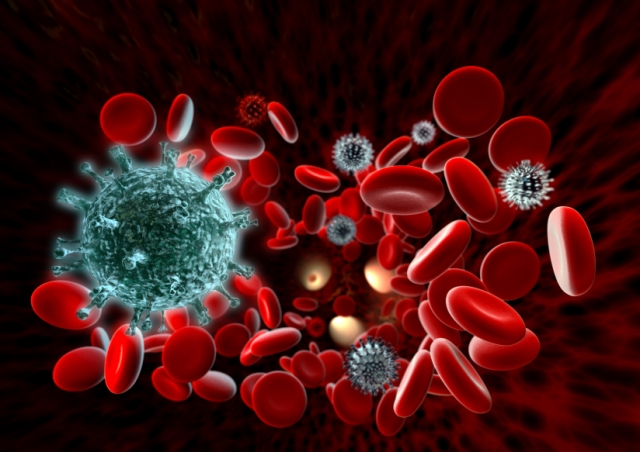
Particle accelerators: making life better since 1932

(cc) dvarg

(cc) dvarg

Atoms form the building blocks of everything that exists in the world, holding chairs, rocks, water and our bodies together in strong, stable structures.

But atoms themselves are made up of lots of composite parts, called sub-atomic particles. Such particles exist in high energy states, and we can find out much more about them using huge particle accelerators, like the Large Hadron Collider. In these machines, atoms are smashed together to leave behind a big pile of sub-atomic debris. This can be sifted through to identify the pieces that are left behind, and to find out exactly how atoms stick so tightly together.

Although it’s fun to hammer atoms together at close to the speed of light, learning more about the structure of matter also impacts our everyday lives. High energy particles are used in electronics, medicine, environmental clean ups and energy production, and exciting new particle accelerator discoveries can be expected to supply a steady stream of future advancements.

Particle accelerators improve medical treatments

High energy particle beams created by miniaturised particle accelerators are currently used in several cancer clinics to shrink tumours. These beams deliver an incredibly precise dose of radiation to cancerous tissue, and come with fewer side effects than traditional therapies. Fourteen centres across Europe currently offer particle accelerator cancer treatments.

Particle accelerators make chocolate smoother

chocolate

Particle accelerators can unravel the molecular structures of different objects. For food scientists, the edible structures of tasty treats can be analysed to discover how different recipes produce the best flavours. For example, particle accelerator experiments have shown that fat-free chocolate CAN be tasty, depending on its atomic structure. Reducing the fat content typically leads to issues that scientists refer to as “poor in-mouth melting properties“. Chocolate recipes made with varying proportions of fats produce bars with different sub-atomic structures, some of which always go down smooth.

Particle accelerators help to clean up the planet

Toxic sludge can spill into the water, land and air, and cleaning it up is a chemically complicated problem. Analysing contaminated samples in a particle accelerator can tell us the exact blend of dirty elements present, what state they exist in and the best ways to purge them from the environment. Such analyses helped to clean up large spills of heavy metals in Hungary after tanks storing contaminated red mud excavated during mining operations accidentally failed.

Allison RR, Sibata C, & Patel R (2013). Future radiation therapy: photons, protons and particles. Future oncology (London, England), 9 (4), 493-504 PMID: 23560373

Do TA, Hargreaves JM, Wolf B, Hort J, & Mitchell JR (2007). Impact of particle size distribution on rheological and textural properties of chocolate models with reduced fat content. Journal of food science, 72 (9) PMID: 18034724

Burke IT, Mayes WM, Peacock CL, Brown AP, Jarvis AP, & Gruiz K (2012). Speciation of arsenic, chromium, and vanadium in red mud samples from the Ajka spill site, Hungary. Environmental science & technology, 46 (6), 3085-92 PMID: 22324637

Posted in Science | Tagged , , , , , | Leave a comment

A Marvellous Month of Science

Taking vitamin supplements might not be as healthy as you think

vitaminsAntioxidant vitamins, like vitamin C and E, are thought to boost health by reducing the creation of DNA-damaging free radicals that can contribute to the ageing process. In lab mice, there is some suggestion that vitamin supplements can extend lifespan, but since laboratory-bred mice are genetic clones, such studies may bear little relevance to a hugely genetically diverse human population.

Giving wild animals, such as the short-tailed field vole, either vitamin C or E supplements has now been shown to have a less positive impact on health. Animals taking either vitamin had a decreased lifespan compared to their non-vitamin chowing counterparts. This aligns with a Cochrane analysis that suggests the same thing happens in humans.

How does the naked mole rat stay cancer-free?

Naked Mole-ratThe naked mole rat is an object of scientific fascination, not just for rocking a quirky look but also for its biological anomalies. In the world of small mammals, it has a remarkably long lifespan (more than 30 years), paired with a complete inability to develop cancer.

Now, a team of researchers led by Xian Tian have shown that the fibroblasts of the naked mole rat, which act as nurturing cells that provide structural and chemical support to other specialised cells, secrete a wonderful version of hyaluronan to produce this anti-cancer effect. Hyaluronan forms part of the extracellular matrix that sticks cells together in a nice ordered pattern. It builds up in naked mole rat cells to protect them by dampening cellular proliferation and inflammation. Removing hyaluronan from these cells renders them sensitive to malignant transformation. Using hyaluronan in the clinic may prove useful for preventing cancer and extending lifespan.

Presenting: the first ultrahigh resolution atlas of the human brain!

Image converted using ifftoanyThe human brain is a fascinating organ that shapes, defines and controls us as individuals. Yet its structure remains frustratingly complex to dissect, and we are only just beginning to understand the anatomical features that can easily be seen by the naked eye. Analysing fine ultrastructural details, including how more than 170 billion neural cells are connected, has proven a tricky task.

To address this issue, a single human brain donated by a 65 year old woman was cut into 7,400 thin slivers, which were stained, photographed and painstakingly fitted back together to create the first high definition 3-D reference map of the human brain. Lovingly known as, “BigBrain”, this new publicly available biological encyclopedia should help us better understand the nature of language, emotions and consciousness.

You can watch a video of the 3-D BigBrain map here: http://youtu.be/nJpFvQ0YZLk

Visit the database here: https://bigbrain.loris.ca/main.php

Stem cells work in shifts to replenish immune patrols in the blood

4. Hemo-StemB and T cells are lethal immune warriors that circulate in the blood and vanquish pathogenic invaders. Yet they don’t live forever, and have to be periodically replenished to maintain immune protection. The sources of this renewal are the haematopoietic stem cells (hSCs) that reside in the bone marrow, where they proliferate to generate their warrior progeny.

A team of researchers from The Netherlands looked at how many fresh B or T cells each individual haematopoietic stem cell added to the total immune cell pool. They found that the contribution of each hSC expanded and declined at different times. When one stem cell was churning out a large number of progeny, the others rested before taking their turn later on. Each stem cell also appeared to be dedicated to producing either B or T cells, and wasn’t able to swap between the two.

Originally posted at Scizzle Blogs

Selman, C., McLaren, J.S., Collins, A.R., Duthie, G.G., & Speakman, J.R. (2013). Deleterious consequences of antioxidant supplementation on lifespan in a wild-derived mammal Biology Letters, 9 (4) DOI: 10.1098/rsbl.2013.0432

Tian X, Azpurua J, Hine C, Vaidya A, Myakishev-Rempel M, Ablaeva J, Mao Z, Nevo E, Gorbunova V, & Seluanov A (2013). High-molecular-mass hyaluronan mediates the cancer resistance of the naked mole rat. Nature, 499 (7458), 346-9 PMID: 23783513

Amunts K, Lepage C, Borgeat L, Mohlberg H, Dickscheid T, Rousseau MÉ, Bludau S, Bazin PL, Lewis LB, Oros-Peusquens AM, Shah NJ, Lippert T, Zilles K, & Evans AC (2013). BigBrain: an ultrahigh-resolution 3D human brain model. Science (New York, N.Y.), 340 (6139), 1472-5 PMID: 23788795

Verovskaya, E., Broekhuis, M.J.C., Zwart, E., Ritsema, M., van Os, R., de Haan, G., & Bystrykh, L.V. (2013). Heterogeneity of young and aged murine hematopoietic stem cells revealed by quantitative clonal analysis using cellular barcoding Blood, 122 (4), 523-532 DOI: 10.1182/blood-2013-01-481135

Posted in Disease, Medicine, Neuroscience, Science | Tagged , , , , , , , , , , , | Leave a comment

Clouds of decoy viruses help cure genetic disease

Helpful viruses get protected by decoy viruses in the bloodstream. Maddy Cow.

Helpful viruses get protected by decoy viruses in the bloodstream. Maddy Cow.

The presence of foreign objects, like viruses, in our bloodstream is usually a bad thing. Evolution has created some extremely efficient immune cells that patrol the blood, seeking out material that should not be there, and shutting it down.

Sometimes, though, viruses circulate in the blood for beneficial purposes. Gene therapies often deliver viruses as couriers to deliver new DNA to repair faulty cells. Getting viruses into the bloodstream is simple, but keeping them “active” during their time inside the body is difficult. This is particularly true if the immune system has encountered them before. Even though therapeutic viruses are engineered to be beneficial, the immune system doesn’t recognise the difference, and starts a defensive response.

Now a team led by Federico Mingozzi at the Children’s Hospital of Philadelphia has come up with a way of preventing such therapeutic viruses from being decommissioned by the immune system, by hiding the virus particles inside a cloud of decoy empty virus particles.

As they report today in the journal Science Translational Medicine, the team developed an engineered version of adeno-associated virus (AAV) as a genetic courier for the treatment of haemophilia B. This disease stems from a mutation in the DNA of liver cells that prevents them from producing normal levels of an enzyme called coagulation factor IX. Such patients can bleed to death without proper treatment.

Mingozzi’s AAV was designed to deliver a DNA payload to the liver. This DNA contained instructions to produce the correct version of coagulation factor IX, a crucial protein involved in blood clotting, in the hope that it would cure this genetic disease.

Stealth tactics

Viruses consist of two parts: a genetic core (either DNA or RNA) and a protective protein shell. When a virus infects a human, the host immune system typically triggers a cascade of defensive reactions. One of the most effective responses is the production of neutralising antibodies that recognise and attach to the virus shell and squelch its activity.

Mingozzi’s choice of AAV as a genetic courier would seem counter-productive then, since between 30% to 60% of the human population has previously been exposed to AAV. Thus, their immune systems have learned to recognise AAV shells. In such immune individuals, even though the engineered version of AAV contains beneficial genetic information, it gets quickly tagged for destruction and obliterated long before it reaches its target destination (the liver).

Even when a large number of AAV particles are administered to improve the odds of some getting through, the immune system mops them up. The few particles that do survive the journey initiate the production of normal coagulation factor IX in liver cells, but only manage to reconstitute around 10% of the normal volume of the coagulation factor IX pool.

So Mingozzi came up with an idea to fool the immune system. He mixed therapeutic AAV particles containing the right genetic information with lots of empty AAV shells lacking a DNA core, and injected them into mice (used as a proxy for humans). This created a smokescreen, allowing the therapeutic AAV particles to dodge the immune system’s attack.

This new approach enhanced AAV survival in the bloodstream of mice. Depending on how immune each individual mouse was to AAV, a personalised ratio of empty AAV particles to real AAV particles was administered. Mice with higher levels of AAV antibodies received more empty decoy shells.

Circulating AAV antibodies, which exist in immune individuals, attacked both empty and active versions of AAV, but enough active virus got to the liver to boost coagulation levels beyond those seen in an average mouse. These beneficial effects lasted up to four weeks – an excellent timeframe given that a severely affected haemophilia B patient has to inject themselves every day.

They also tested out the same idea using animals more closely related to humans – rhesus macaques – where the presence of decoy virus gave real AAV particles the same survival extension, and boosted coagulation factor IX levels to a similar degree.

Importantly, when different monkey tissues were examined after administering empty and real AAV formulations, all the activity predominantly happened in the liver, with no unsafe, off-target effects in other organs.

Perfecting the decoy trap

The first generation of decoy viruses used in this study were designed to be exact replicas of AAV, but without the DNA payload. Unfortunately, these decoy viruses behaved too much like the real thing, attaching to target liver cells and by virtue of their overwhelming numbers, out-competing the binding of real, therapeutically-relevant virus. Once inside liver cells, bits of these empty viruses then presented enticing foreign targets to the immune system.

Tweaking the design of the empty virus shell in the second generation of decoy viruses prevented it from binding liver cells, boosted the binding of real virus and replicated the rise in coagulation factor IX levels. It also had the happy consequence of dampening certain sections of the immune response.

Using fake viruses as bodyguards is an ingenious way of protecting therapeutic viruses in the bloodstream. This approach could represent the start of a therapeutic revolution for haemophilia B patients, and others with genetic diseases.

(Originally posted on The Conversation).

Mingozzi, F., Anguela, X.M., Pavani, G., Chen, Y., Davidson, R.J., Hui, D.J., Yazicioglu, M., Elkouby, L., Hinderer, C.J., Faella, A., Howard, C., Tai, A., Podsakoff, G.M., Zhou, S., Basner-Tschakarjan, E., Fraser Wright, J., & High, K.A. (2013). Overcoming Preexisting Humoral Immunity to AAV Using Capsid Decoys Science Translational Medicine, 5 (194)

Posted in Disease, Genetics, Medicine, Microorganisms, Science, Viruses | Tagged , , , , , , , , , | Leave a comment

Gene therapy using stem cells prevents inherited diseases

Originally written for The Conversation.

Gene therapy: not just for mice. J. Bradbury.

Gene therapy: not just for mice. J. Bradbury.

Genetic traits like a bulbous nose or balding give some people reasons to moan about what they inherited from their parents. But more serious genetic flaws can cause debilitating disease. Now, Italian researchers have come up with a way of treating one such inherited disease and reversing another using a promising new method of gene therapy.

The idea behind gene therapy is to replace a faulty gene with a shiny new version that works properly. Modified versions of viruses, which have been sculpted by millions of years of evolution, perfectly penetrate human cells. They act as couriers delivering DNA payloads to defective cells and ensure it is stably inherited.

This deceptively simple idea, though, has been challenging to achieve in practice. The first commercial gene therapy product, Glybera, only received regulatory approval in 2012.

Part of the reason for this is the difficulty of successfully clearing three hurdles at once: delivering replacement genetic information to the exact cells that need help, getting this information safely translated in high enough volumes to overcome the defects and stopping the immune system from reacting to “normal” genes when it has grown used to only seeing mangled ones.

Now, a team led by Alessandra Biffi at the San Raffaele Scientific Institute in Milan, Italy reports in the journal Science that they have developed a new approach that navigates each of these hurdles to treat three children with metachromatic leukodystrophy (MLD), a devastating inherited disease that affects around 1 in 40,000 people.

Engineered stem cells

MLD usually manifests in early childhood and kills patients just a few years after the first symptoms appear. It is caused by a defect in a single gene, ARSA. This gene encodes information used by the lysosome, a piece of recycling machinery used by human cells to break down unwanted material. When this recycling process does not work properly in nerve cells, as is the case with MLD patients, they become filled with rubbish and begin to slowly decline, leading to brain and spinal cord degeneration, as well as sensory deprivation.
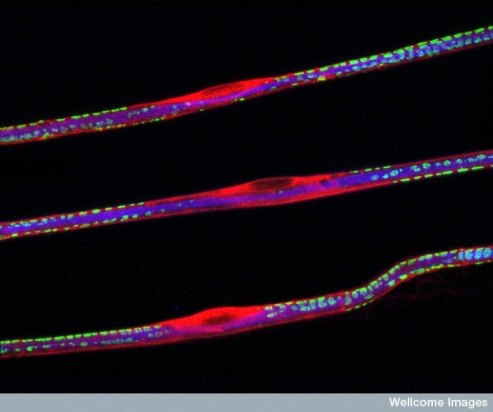
Defects in a single gene knock out lysosomal activity in nerve cells of the central and peripheral nervous system in metachromatic leukodystrophy patients. Peter Brophy, Wellcome Images.

Defects in a single gene knock out lysosomal activity in nerve cells of the central and peripheral nervous system in metachromatic leukodystrophy patients. Peter Brophy, Wellcome Images.

Supplying a replacement ARSA gene to affected cells in the nervous system is a tricky task, because these areas are heavily protected. To overcome these defences, the team employed haematopoietic stem cells (HSCs), which can usually be found nestling quietly in the bone marrow, as stealthy genetic couriers. A tiny number of these cells were harvested from each patient, loaded with benign viruses carrying a working copy of ARSA and put back into the bloodstream.

These engineered cells either lodged in the bone marrow or continued to travel around the body in the blood, where they corrected defective cells in the nervous system by supplying the normal version of ARSA. Because these were stem cells, they also reproduced to form new blood cells that themselves took on the same supportive roles.

Resurrecting lysosomes from the dead

Most MLD patients produce a garbled version of ARSA that has a very low level of activity, nowhere near enough to let the lysosome carry out its normal job. Restoring partial activity is not enough to make a clinical impact – levels must be hiked to make an obvious difference.

One way of maximising activity is to pack defective cells with lots of normal copies of the same genetic message. In this case, haematopoietic stem cell couriers were loaded with two to four copies of the same virus, introducing multiple reproductions of the normal ARSA gene into the host cell genome.

To check that these viral inserts did not cause any unintended biological disruptions, which could lead to very serious side effects (like leukaemia), every individual founder cell infused into the patients was tracked using a genetic barcode. While some original cells generated large pools of daughter cells early on, which could be a sign of dangerously uncontrolled growth, none of them continued to dominate the blood cell pool as time went by.

In the patients, levels of ARSA quickly skyrocketed to above-average concentrations in both the original courier stem cells and their progeny. More than a year after treatment, normal ARSA levels were detected in the cerebrospinal fluid of all three patients, a clear sign that the central nervous system had stabilised. All these kids, who have older siblings badly affected by the same disease, can now think, run, jump, sit, crawl, kneel, jump, roll and speak like similarly aged average preschoolers.

Using the same technique, in a separate paper in Science, a team led by Alessandro Aiuti of the same institute in Italy showed reversal of the Wiskott-Aldrich syndrome (WAS) in three other young patients.

Like MLD, WAS is also a disease caused by a defect in a single gene. The disease causes immune system dysfunction that leaves kids at high risk of infections, bleeding and being harmed by their own immune system. But HSCs loaded with viruses containing the correct version of the faulty gene were able to restore a properly functioning immune system.

Using this stem cell-based gene therapy technique, both these new studies have either prevented the onset of a serious neurodegenerative disease, or reversed existing immunological disease. These are a testament to the tremendous potential of gene therapy and they represent a great step towards long-lasting cures for single-gene diseases.

Biffi A, Montini E, Lorioli L, Cesani M, Fumagalli F, Plati T, Baldoli C, Martino S, Calabria A, Canale S, Benedicenti F, Vallanti G, Biasco L, Leo S, Kabbara N, Zanetti G, Rizzo WB, Mehta NA, Cicalese MP, Casiraghi M, Boelens JJ, Del Carro U, Dow DJ, Schmidt M, Assanelli A, Neduva V, Di Serio C, Stupka E, Gardner J, von Kalle C, Bordignon C, Ciceri F, Rovelli A, Roncarolo MG, Aiuti A, Sessa M, & Naldini L (2013). Lentiviral Hematopoietic Stem Cell Gene Therapy Benefits Metachromatic Leukodystrophy. Science (New York, N.Y.) PMID: 23845948

Aiuti A, Biasco L, Scaramuzza S, Ferrua F, Cicalese MP, Baricordi C, Dionisio F, Calabria A, Giannelli S, Castiello MC, Bosticardo M, Evangelio C, Assanelli A, Casiraghi M, Di Nunzio S, Callegaro L, Benati C, Rizzardi P, Pellin D, Di Serio C, Schmidt M, Von Kalle C, Gardner J, Mehta N, Neduva V, Dow DJ, Galy A, Miniero R, Finocchi A, Metin A, Banerjee P, Orange J, Galimberti S, Valsecchi MG, Biffi A, Montini E, Villa A, Ciceri F, Roncarolo MG, & Naldini L (2013). Lentiviral Hematopoietic Stem Cell Gene Therapy in Patients with Wiskott-Aldrich Syndrome. Science (New York, N.Y.) PMID: 23845947


Posted in Disease, Genetics, Medicine, Science | Tagged , , , , , , , , | Leave a comment

MESSENGER spacecraft helps uncover Mercury’s pummelled past

mercuryIn our solar system, Mercury is the teeniest planet, and nestles closest to the sun. Understanding how Mercury developed as the solar system formed is an intriguing question for space science, and a surprising amount of information can be uncovered by analysing the topographical atlas of Mercury’s surface.

The Mariner 10 spacecraft, which launched in 1973, sent back photographs of just under half of Mercury’s surface. Now, American researchers have used images from the glossy, ultramodern MESSENGER spacecraft (launched in 2004) that visualise the entire surface to identify new landscape features that might help to explain more about Mercury’s history.

They found that the oldest areas of Mercury were pockmarked with huge craters (10 – 1,000 km wide) that hail from an intense period of history around 4 billion years ago known as the Late Heavy Bombardment. This was a time when huge fields of asteroids and comets travelled through space and cannoned into different planets of our solar system, including Mercury and the moon (interestingly, Earth doesn’t show much evidence from this period since active tectonic plates and erosion constantly resculpt the planet’s surface).

Then, around 3.8 billion years ago, several areas of Mercury’s terrain appear to have been smoothed out by intense volcanic activity extending across the planet, erasing evidence of past craters. Since such smoothened areas mostly peter out towards the end of the Late Heavy Bombardment period, these volcanoes were likely activated by the constant impact of asteroids and comets.

Paper: http://goo.gl/PoHep

Marchi S, Chapman CR, Fassett CI, Head JW, Bottke WF, & Strom RG (2013). Global resurfacing of Mercury 4.0-4.1 billion years ago by heavy bombardment and volcanism. Nature, 499 (7456), 59-61 PMID: 23823793

Posted in Science, Space | Tagged , , , , , , , , | Leave a comment